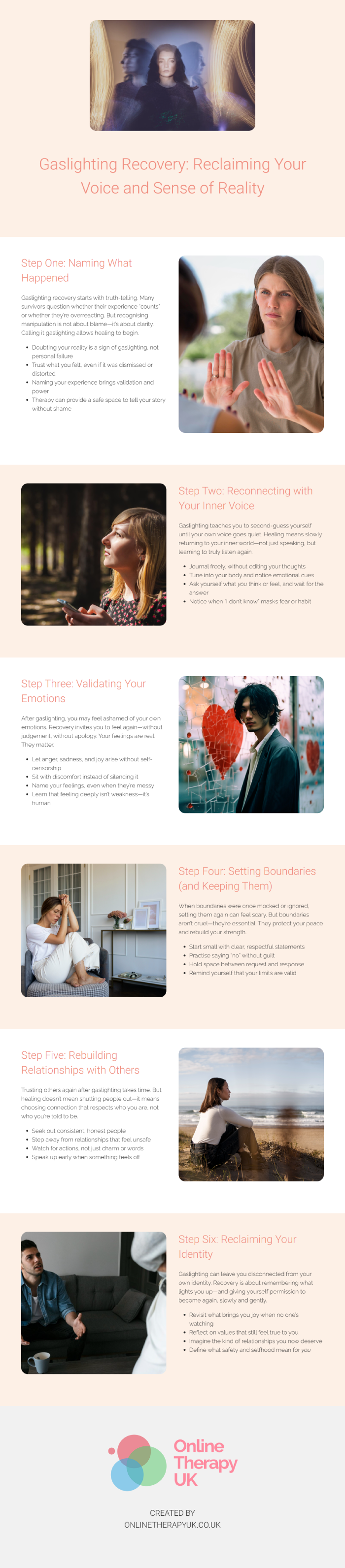
Gaslighting is not just manipulation—it’s a dismantling of your sense of self. Over time, it erodes your trust in your thoughts, feelings, and perceptions. It leaves you questioning what’s real, what’s true, and whether your pain is valid. And perhaps the most devastating part? It often happens gradually, disguised as care, concern, or love.
If you’ve been gaslighted—by a partner, a parent, a boss, or even a therapist—you’re not alone. And you’re not broken. The confusion, self-doubt, and emotional exhaustion you feel are real. But recovery is possible. You can learn to trust yourself again. You can reclaim your voice.
This post explores what gaslighting is, how it impacts your inner world, and the therapeutic steps you can take to reconnect with your own truth.
What Is Gaslighting?
Gaslighting is a form of psychological manipulation where someone makes you doubt your memory, perception, or sanity. It can look like:
- Minimising your feelings: “You’re overreacting.”
- Denial of facts: “That never happened.”
- Shifting blame: “You made me do it.”
- Undermining confidence: “You’re too sensitive / dramatic / emotional.”
- Rewriting reality: “You always twist things.”
Over time, these comments chip away at your self-trust. You begin to second-guess everything—your emotions, your decisions, even your identity. You start to rely on the other person’s version of events, even when something deep inside tells you it’s off.
The Lingering Impact of Gaslighting
Even after the relationship or situation ends, the effects of gaslighting can persist. The manipulator may be gone, but the voice they implanted remains—echoing through your thoughts, choices, and relationships.
Some common signs of post-gaslighting trauma include:
- Chronic self-doubt, even in small decisions
- Difficulty trusting others—and yourself
- **Anxiety around expressing opinions or emotions
- Perfectionism as a way to avoid criticism or conflict
- Emotional numbness, or feeling detached from your experiences
- Fear of being “too much” or “too sensitive”
Gaslighting doesn’t just distort your reality—it disconnects you from your inner compass. That’s why recovery is about more than recognising what happened. It’s about rebuilding a relationship with yourself.
Step One: Naming What Happened
The first step in healing is naming the experience. Many survivors hesitate to use the word gaslighting—fearing it’s too dramatic or not quite accurate. This uncertainty is part of the wound.
You may find yourself thinking:
- “Maybe I misunderstood.”
- “It wasn’t that bad.”
- “They had a hard childhood—it’s not their fault.”
- “What if I was the problem?”
But here’s the truth: if someone consistently made you question your feelings, rewrite your memories, or distrust your instincts, that is gaslighting. And recognising it as such is not about blame—it’s about clarity. It’s about honouring your experience, not minimising it.
Therapy can help you hold this truth safely. A compassionate therapist won’t rush to pathologise or diagnose—but they will believe you.
Step Two: Reconnecting with Your Inner Voice
One of the cruelest effects of gaslighting is the silencing of your inner voice. You may have learned to dismiss your emotions before they even reached the surface. In recovery, the goal isn’t just to speak—but to hear yourself again.
This process takes time. It might begin with:
- Journaling your unfiltered thoughts, without editing or judging
- Practising mindfulness to observe how emotions show up in your body
- Asking yourself, “What do I think? What do I feel?”—and waiting for the answer
- Noticing when you say “I don’t know” out of habit or fear
Your inner voice may feel quiet or inconsistent at first. But it’s not gone. It’s waiting for permission to return.
Step Three: Validating Your Emotions
Gaslighting teaches you that your emotions are excessive, irrational, or wrong. Recovery is about learning to feel again—without shame or apology.
This might mean:
- Allowing yourself to feel anger without pushing it away
- Sitting with sadness, even when it makes you feel “weak”
- Letting joy arise without fearing it will be taken away
- Naming your emotions without justifying them
A therapist can offer emotional mirroring—reflecting your feelings back to you with validation and compassion. This helps rebuild your emotional confidence. Over time, you begin to trust: If I feel it, it matters.
Step Four: Setting Boundaries (and Keeping Them)
Boundaries are often where gaslighting hits hardest. You may have had your limits ignored, mocked, or punished. As a result, saying “no” might now feel terrifying.
But boundaries are not selfish. They are acts of self-respect.
Start with small, manageable steps:
- “I’m not available for that right now.”
- “Please don’t speak to me that way.”
- “I need some time to think before I answer.”
- “That doesn’t work for me.”
Therapy offers a safe space to practise these boundaries. You learn that holding your limits doesn’t make you cold—it makes you whole.
Step Five: Rebuilding Relationships with Others
Once you start to trust yourself again, you may find it difficult to trust others. That’s understandable. When someone has manipulated your reality, it’s natural to be wary.
But humans are wired for connection. The goal of recovery isn’t isolation—it’s learning how to connect without losing yourself.
You may begin to:
- Gravitate toward relationships where honesty and accountability are present
- Let go of connections that feel performative or unsafe
- Seek out people who are consistent—not just charming or attentive
- Speak up when something doesn’t feel right
Therapy can also help you explore attachment patterns, rebuild relational trust, and differentiate between red flags and old fears.
Step Six: Reclaiming Your Identity
Gaslighting doesn’t just distort your thoughts—it can eclipse your entire identity. You may forget what you liked, who you were, or what mattered to you before the manipulation began.
Part of healing is remembering—and reimagining—yourself.
Ask yourself:
- What do I enjoy when no one’s watching?
- What values guide me?
- What kind of relationships do I want?
- What does safety look like for me now?
Therapy helps create a space where these questions can unfold slowly, gently, without pressure. You’re not rebuilding who you should be—you’re rediscovering who you already are.
What Gaslighting Recovery Looks Like Over Time
Recovery is not a straight line. Some days you’ll feel clear and strong. Other days you might spiral into doubt. This is normal. Healing happens in layers, not milestones.
Here are some signs that healing is taking root:
- You pause before blaming yourself
- You notice manipulation without absorbing it
- You trust your instincts, even when others disagree
- You set boundaries without guilt
- You speak—and believe—your truth
These shifts might seem subtle, but they’re seismic. They’re proof that your inner world is no longer being dictated by someone else’s narrative.
Why Therapy Is a Critical Part of the Process
Gaslighting attacks your reality. Therapy helps you rebuild it.
With the support of a trained professional, you don’t just understand what happened—you experience what it feels like to be believed, respected, and supported without agenda.
In therapy, you can:
- Explore the origins of your self-doubt
- Name the trauma without being silenced
- Reclaim agency over your narrative
- Practise new relational dynamics in a safe space
- Build a life that reflects your truth, not someone else’s distortion
At Online Therapy UK, our therapists are trained in trauma-informed care. Whether you’re in the early stages of recognising gaslighting or deep in recovery, we offer a grounded, compassionate space to support your journey.
Final Words: You Are Not What Was Done to You
Gaslighting can feel like erasure. It can convince you that you are wrong, broken, or unlovable. But none of that is true. What happened to you was real. Your pain is valid. And your truth still lives within you.
Recovery is not about becoming someone new—it’s about remembering who you were before someone told you not to trust yourself.
It’s about returning to the quiet wisdom of your own body, voice, and perception.
It’s about reclaiming what was always yours: your story, your boundaries, your sense of reality.
You don’t have to do it alone.
If you’re ready to begin healing, we’re here to walk beside you.
At Online Therapy UK, you’ll find experienced, compassionate professionals who believe in your right to feel, to speak, and to be fully seen—without distortion, denial, or dismissal.
Your voice matters.
Your reality matters.
You matter.