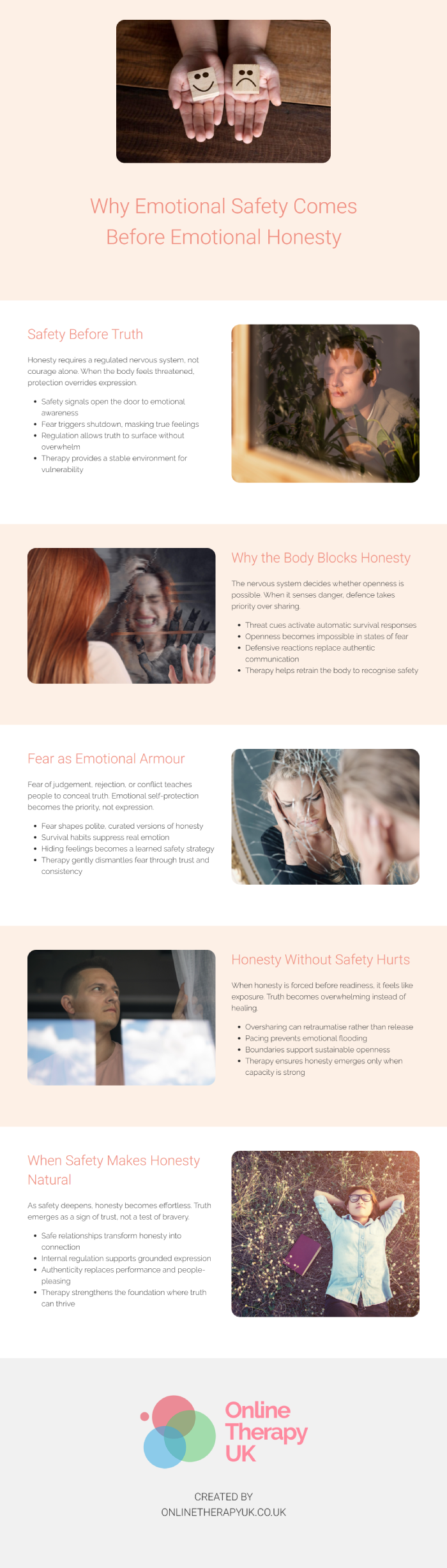
Emotional honesty is often described as the heart of healing — the ability to name your truth, express your feelings, and be fully seen. Yet honesty cannot exist where safety is absent. For someone whose nervous system has learned that vulnerability brings threat or rejection, being truthful about inner experience feels dangerous. Before honesty can emerge, safety must first be built, gently and consistently.
Therapy provides that foundation. It teaches that emotional safety isn’t the same as comfort or avoidance; it’s the environment that allows truth to surface without fear of punishment. When you feel safe enough to stay connected — even while uncomfortable — honesty stops being a risk and becomes a natural act of self-expression.
Why Safety Is the Prerequisite for Truth
To speak honestly, you must first feel safe enough to stay present. If the body senses threat, the mind retreats to protection — rationalising, minimising, or numbing feelings to prevent further harm. Emotional honesty requires regulation; without it, you’re simply surviving, not revealing. True safety doesn’t erase discomfort, but it anchors you through it.
Therapy helps you learn this balance: creating internal steadiness so that your truth can be voiced without collapsing or fleeing.
- The body prioritises safety over honesty in perceived danger.
- Truth-telling requires access to calm, not chaos.
- Regulation allows emotion to be expressed rather than acted out.
- Therapy provides a safe environment to practise vulnerability.
The Biology of Emotional Safety
Safety is physiological before it’s psychological. The nervous system scans constantly for cues of threat or support, determining whether openness is possible. If safety isn’t detected, defensive responses like freezing, dissociating, or people-pleasing take over. These aren’t choices — they’re automatic. Only when the body feels secure does honesty become accessible.
Therapy works with the body to restore this sense of security, allowing emotional honesty to unfold naturally instead of being forced.
- The nervous system governs our readiness for openness.
- Threat cues activate protective, not expressive, responses.
- Safety signals regulate the body and open space for truth.
- Therapy helps the body experience calm before disclosure.
How Fear Silences the Truth
Emotional honesty becomes impossible when fear dominates the inner landscape. Fear of rejection, abandonment, judgement, or conflict teaches people to hide their real feelings behind politeness or performance. You learn to speak safely, not authentically, shaping yourself to keep peace rather than tell truth.
Therapy helps you explore these fears gently, replacing survival silence with self-trust — the confidence that honesty will no longer cost connection.
- Fear of loss or rejection suppresses emotional expression.
- Self-protection replaces transparency when trust feels unsafe.
- Politeness and performance become emotional armour.
- Therapy reintroduces honesty through safety, not exposure.
The Difference Between Honesty and Exposure
Honesty and exposure are not the same. Honesty emerges from choice; exposure happens when vulnerability exceeds capacity. Without safety, revealing too much too soon can re-create trauma rather than resolve it. The goal of therapy is not to push for raw truth, but to create conditions where truth can unfold without retraumatisation.
In this way, safety acts as a container — protecting the process of disclosure so that honesty strengthens rather than destabilises.
- Exposure without safety can feel violating, not healing.
- Honesty thrives within boundaries that preserve control.
- Gradual pacing builds tolerance for emotional truth.
- Therapy ensures expression happens safely and sustainably.
The Role of the Therapist in Creating Safety
Therapists don’t demand honesty; they invite it. By listening without judgement, regulating their own presence, and respecting boundaries, they create a relationship where honesty can arise organically. The safety they model helps you internalise a new pattern — one where openness is met with compassion instead of consequence.
This relational trust becomes the blueprint for how you later engage with yourself and others outside therapy.
- Therapists model calm, regulated, and non-judgemental presence.
- Consistent empathy re-teaches the nervous system that vulnerability is safe.
- Boundaries protect against emotional overwhelm or retraumatisation.
- Therapy transforms trust into a lived, embodied experience.
Emotional Honesty Without Safety: What It Looks Like
Without safety, attempts at honesty often turn chaotic or defensive. You might express truth through anger, sarcasm, or withdrawal — anything that distances you from the risk of being hurt. What appears as truth-telling may actually be the nervous system in protection mode, trying to control or escape pain.
Therapy helps you recognise these patterns, teaching that genuine honesty requires calm, not confrontation.
- Emotional expression can become reactive without regulation.
- “Honesty” expressed through defence often conceals deeper fear.
- Safety enables reflection instead of reactivity.
- Therapy helps transform protective expression into authentic communication.
Why Forcing Honesty Backfires
Forcing emotional honesty before safety is established often leads to shutdown. The body interprets it as exposure, not liberation. This can reinforce shame or avoidance, confirming the belief that truth is dangerous. Healing requires patience — letting honesty emerge at the pace of trust, not urgency.
Therapy respects this timing, understanding that too much, too soon, can hinder progress rather than accelerate it.
- Forcing disclosure reactivates fear and defensive responses.
- Emotional pacing protects against retraumatisation.
- Authentic truth-telling unfolds through safety, not speed.
- Therapy honours readiness as a marker of real progress.
Building Internal Safety: The Foundation of Openness
Safety doesn’t only exist in relationships; it can also be built within. When you learn to regulate your emotions, comfort yourself, and stay grounded, honesty becomes less threatening. You can face discomfort without collapsing into panic or self-criticism. Internal safety means your truth has a safe listener — you.
Therapy strengthens this self-trust, helping you build internal stability to hold emotional truth without fear.
- Internal regulation reduces dependence on external reassurance.
- Self-compassion anchors honesty in emotional steadiness.
- Inner safety turns vulnerability into strength, not risk.
- Therapy helps develop internal containment for difficult truths.
The Role of Boundaries in Emotional Safety
Boundaries protect emotional truth. They determine when, how, and with whom to share your feelings. Without boundaries, honesty can feel exposing or invalidated; with them, it becomes empowered and respectful. Setting limits is not secrecy — it’s the framework that makes transparency sustainable.
Therapy supports you in defining boundaries that preserve both openness and emotional security.
- Boundaries protect vulnerability from misuse or dismissal.
- Clear communication prevents emotional depletion.
- Safety and honesty coexist through mutual respect.
- Therapy helps balance self-disclosure with self-protection.
The Slow Work of Trust
Trust doesn’t form instantly; it builds through consistent experiences of being seen and not shamed. Each time you risk honesty and are met with compassion, the nervous system rewrites its expectations. Over time, what once felt unsafe becomes tolerable — and then natural.
Therapy fosters this gradual expansion, teaching that trust is a practice, not a promise.
- Trust grows through repetition, not revelation.
- Positive emotional experiences rewire old fear responses.
- Safety accumulates through consistency, not intensity.
- Therapy provides reliable connection for trust to deepen.
Emotional Honesty as an Outcome, Not a Goal
Many people enter therapy believing that honesty is the goal — to confess, release, or “get it all out.” But honesty isn’t something you do; it’s something that arises when safety allows. The process cannot be forced or rushed, because truth requires space to breathe.
Therapy reframes honesty as a symptom of safety — a natural expression of a nervous system that finally trusts it will not be harmed for being authentic.
- Honesty is the fruit of safety, not its prerequisite.
- Truth arises spontaneously in safe relational contexts.
- Forced openness bypasses emotional readiness.
- Therapy creates safety that lets honesty unfold organically.
How Shame Interferes with Emotional Honesty
Shame thrives in secrecy and silence. When internalised messages tell you that your emotions are “too much” or “wrong,” you learn to hide them to preserve belonging. Shame disconnects you from authenticity and replaces truth with performance. Emotional safety dismantles shame by allowing expression without punishment.
Therapy helps replace shame’s voice with compassion, making honesty possible again.
- Shame suppresses authenticity to maintain perceived safety.
- Emotional suppression reinforces disconnection and fear.
- Compassion and validation dissolve shame-based barriers.
- Therapy restores permission to feel and express truth safely.
The Interplay Between Safety and Courage
Safety doesn’t eliminate courage — it empowers it. Without safety, courage becomes survival; with it, courage becomes choice. When you feel supported, you can take emotional risks that previously felt impossible. Safety expands your capacity for bravery rather than replacing it.
Therapy builds this dynamic balance, helping you step into truth with both strength and softness.
- Safety strengthens, not weakens, emotional courage.
- Courage becomes grounded rather than reactive.
- Honesty requires bravery supported by regulation.
- Therapy nurtures courage through consistent relational safety.
Relearning What Honesty Feels Like
If you’ve spent years suppressing truth, emotional honesty may initially feel uncomfortable — even wrong. Your body might tense, your voice might shake, or guilt may surface. This is not a sign of regression but recalibration. You’re teaching your nervous system that honesty no longer equals danger.
Therapy normalises this discomfort, helping you stay present through it until honesty feels like relief rather than threat.
- Discomfort is natural when old defences begin to relax.
- The body must relearn that expression is safe.
- Emotional honesty grows easier with repetition and support.
- Therapy helps transform fear-based honesty into embodied truth.
Moving from Safety to Authentic Connection
Once safety is established, honesty deepens relationships — both with yourself and others. It allows for repair, intimacy, and genuine understanding. You no longer speak to control outcomes but to express alignment with your truth. Connection becomes mutual rather than performative.
Therapy supports this transition from guardedness to authentic relating.
- Safety paves the way for real, not reactive, communication.
- Emotional honesty strengthens empathy and mutual respect.
- Connection replaces performance as the foundation of relationship.
- Therapy reinforces relational authenticity through shared trust.
Integration: Safety as the Ground of Authentic Living
Emotional safety and honesty are not opposites — they are partners. Safety grounds you; honesty frees you. Together, they create a life built on truth that doesn’t harm and vulnerability that doesn’t collapse. When safety comes first, honesty can grow roots deep enough to hold the whole truth without fear.
Therapy anchors this integration, helping you live from a place where being authentic no longer feels dangerous, but deeply human.
- Emotional safety stabilises honesty into sustainable authenticity.
- Regulation allows truth to emerge without overwhelm.
- Safety transforms honesty from risk into relationship.
- Therapy models a balance of openness and containment.
Conclusion
Emotional honesty is powerful, but without safety, it can wound rather than heal. Safety is the soil where truth can take root — the nervous system’s permission slip for openness. When you build safety first, honesty ceases to be an act of bravery and becomes an act of being.
At Online Therapy UK, we help clients create this foundation of safety before exploring the deeper layers of truth. Through compassion, regulation, and trust, honesty emerges not as exposure, but as expansion — the natural outcome of feeling safe enough to be fully yourself.