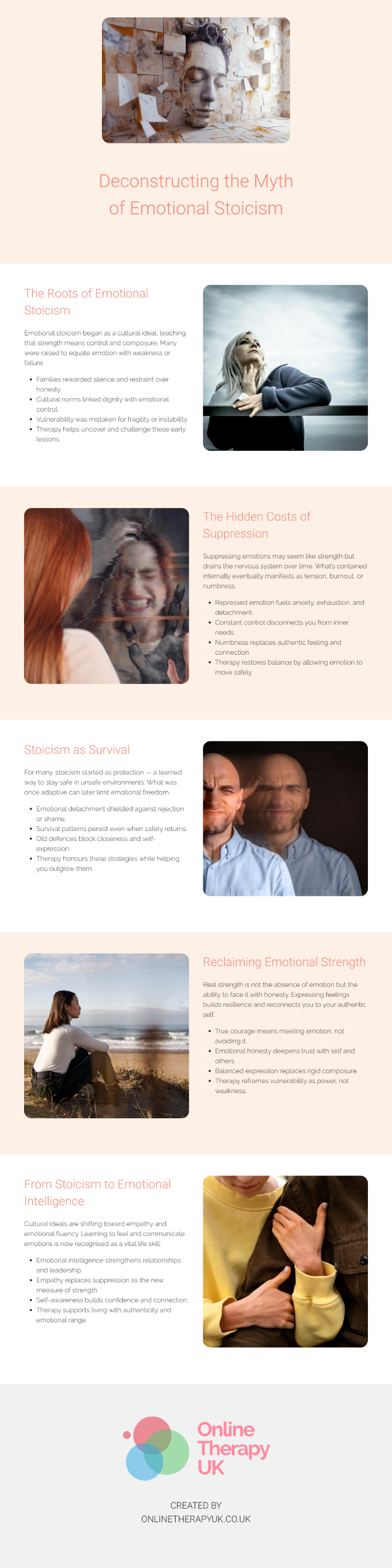
For generations, emotional stoicism has been praised as a sign of strength. The ability to suppress tears, control reactions, and appear unaffected has been idealised in many cultures, workplaces, and families. Yet behind this image of composure often lies disconnection, loneliness, and unprocessed pain. Emotional suppression may look like resilience, but it often hides the opposite — an exhausted nervous system struggling to stay contained.
The myth of emotional stoicism teaches people that vulnerability is weakness and that control equals power. Therapy challenges this illusion, helping individuals reconnect with emotional honesty as a foundation for genuine strength. This blog explores where stoicism originates, why it persists, and how therapy helps people move from suppression to authentic expression.
The Origins of Emotional Stoicism
The ideal of emotional stoicism has deep cultural and historical roots. In many societies, showing emotion was considered undisciplined, especially for men or authority figures. From childhood, people learned that composure and control were rewarded, while emotional expression was shamed or dismissed.
These early lessons became internalised beliefs — that safety comes from hiding feelings, and that emotional expression leads to rejection or ridicule. Therapy helps uncover these origins, allowing clients to question whether these inherited values truly serve them.
- Cultural norms teach that strength equals emotional control.
- Families may reinforce stoicism through shaming or avoidance.
- Early conditioning links vulnerability with danger or weakness.
- Therapy explores and challenges these inherited emotional rules.
The Cost of Constant Composure
Maintaining composure at all times carries an emotional price. Suppressed feelings do not disappear; they build tension in the body, contributing to stress, burnout, or physical symptoms. Over time, the pressure to stay composed can lead to anxiety, depression, or emotional numbness.
Therapy helps identify the hidden costs of stoicism, reframing emotional expression as a form of regulation rather than instability. Releasing emotion safely allows the nervous system to reset, restoring balance and vitality.
- Suppressed emotions accumulate as stress and fatigue.
- Constant control can lead to anxiety and disconnection.
- Emotional numbness replaces vitality and spontaneity.
- Therapy helps release emotion safely to restore balance.
The Gendered Nature of Stoicism
Emotional stoicism is often gendered. Boys are told not to cry, while girls are told not to be “too sensitive.” These messages shape how people relate to their emotions throughout life, influencing how they express care, anger, or grief.
In therapy, clients explore how these messages limited emotional freedom and contributed to misunderstanding in relationships. Healing means reclaiming the full emotional range that was once suppressed by gendered expectations.
- Cultural conditioning links masculinity with emotional restraint.
- Femininity is often shamed for emotional intensity.
- These messages restrict authentic expression for everyone.
- Therapy supports reclaiming emotional honesty beyond gender roles.
Stoicism as a Survival Strategy
For many, stoicism began as a way to survive. If expressing fear or sadness led to rejection, the nervous system learned to hide those feelings as protection. What looks like emotional detachment is often a learned defence against past pain.
Therapy reframes stoicism as an adaptive strategy that once made sense. Rather than judging it, therapy honours its origins while helping clients find safer ways to express emotion in the present.
- Stoicism often develops as a response to unsafe environments.
- Emotional detachment protects against rejection or ridicule.
- Suppression was once adaptive but now limits connection.
- Therapy honours old defences while building new coping tools.
The Illusion of Control
Stoicism offers the illusion of control — the sense that managing emotions equals managing life. But suppressing emotion does not prevent chaos; it simply hides it. Under the surface, unacknowledged feelings continue to influence behaviour and relationships.
Therapy helps dismantle this illusion by showing that control and expression can coexist. Feeling emotions does not make you powerless; it makes you present and capable of responding consciously.
- Stoicism equates emotional control with personal strength.
- Hidden feelings still influence actions and reactions.
- True control comes from awareness, not suppression.
- Therapy supports mindful expression instead of emotional avoidance.
How Stoicism Impacts Relationships
Emotional stoicism can make closeness difficult. When one person avoids showing vulnerability, others may feel shut out or rejected. Over time, relationships can become surface-level, missing the intimacy that comes from shared emotion.
Therapy helps clients recognise how stoicism shapes connection. Learning to express emotion safely creates deeper bonds built on trust, honesty, and empathy — qualities impossible to cultivate through emotional avoidance.
- Stoicism limits vulnerability and authentic closeness.
- Partners or friends may feel emotionally unseen.
- Suppressed emotion fuels misunderstanding and distance.
- Therapy builds skills for open, balanced emotional connection.
The Role of the Nervous System
Stoicism often reflects a nervous system in survival mode. When safety feels uncertain, the body prioritises control and composure to avoid overwhelm. This physiological response becomes habitual, even when danger is no longer present.
Therapy works directly with the nervous system, helping clients notice and regulate these states. As safety increases, the body gradually allows emotions to surface without fear of collapse.
- Stoicism keeps the nervous system in chronic defence mode.
- Emotional control often masks physiological tension.
- Regulation makes space for emotion without overwhelm.
- Therapy restores safety so emotions can flow freely again.
Reclaiming Emotional Range
Healing from stoicism means expanding your emotional range. This does not mean becoming overly reactive but allowing joy, sadness, anger, and tenderness to coexist. The goal is not to lose composure but to feel fully and respond appropriately.
In therapy, clients practise naming emotions, understanding their origins, and expressing them without shame. Over time, this restores energy, authenticity, and connection with others.
- Healing expands your capacity to feel a full range of emotions.
- Balanced expression replaces repression or overreaction.
- Naming emotions builds clarity and self-awareness.
- Therapy supports emotional fluency and acceptance.
Emotional Honesty as True Strength
The myth of stoicism confuses silence with strength. Real strength is not the absence of feeling but the ability to face emotion with courage. Expressing fear, grief, or love openly requires far more bravery than denying them.
Therapy reframes emotional honesty as resilience — the willingness to stay present with what arises rather than hiding behind composure. This kind of strength builds self-trust and deeper human connection.
- Emotional honesty requires courage, not weakness.
- Suppression avoids discomfort but blocks growth.
- Facing emotions strengthens self-trust and confidence.
- Therapy redefines vulnerability as a form of resilience.
The Cultural Shift Toward Emotional Intelligence
Across workplaces, schools, and communities, emotional intelligence is gradually replacing the ideal of stoicism. People are recognising that empathy, self-awareness, and communication create stronger teams and relationships than rigid control ever could.
Therapy contributes to this shift by helping individuals lead with authenticity. When you show up emotionally present, you model a new kind of strength that invites others to do the same.
- Emotional intelligence values awareness over suppression.
- Cultural shifts prioritise empathy and communication.
- Authentic leadership replaces the myth of detachment.
- Therapy supports individuals in embodying this change.
Conclusion
Emotional stoicism has long been mistaken for strength, but it often hides pain, fear, and exhaustion. True resilience comes not from suppressing emotion but from meeting it with honesty and compassion. Therapy helps dismantle the myths that keep people silent, teaching that openness is not weakness but the essence of connection and courage.
At Online Therapy UK, we believe that healing begins with feeling. By learning to express emotions safely, you free yourself from the burden of constant control and rediscover the power of authentic living. When you let go of emotional stoicism, you make space for the full, vibrant experience of being human.