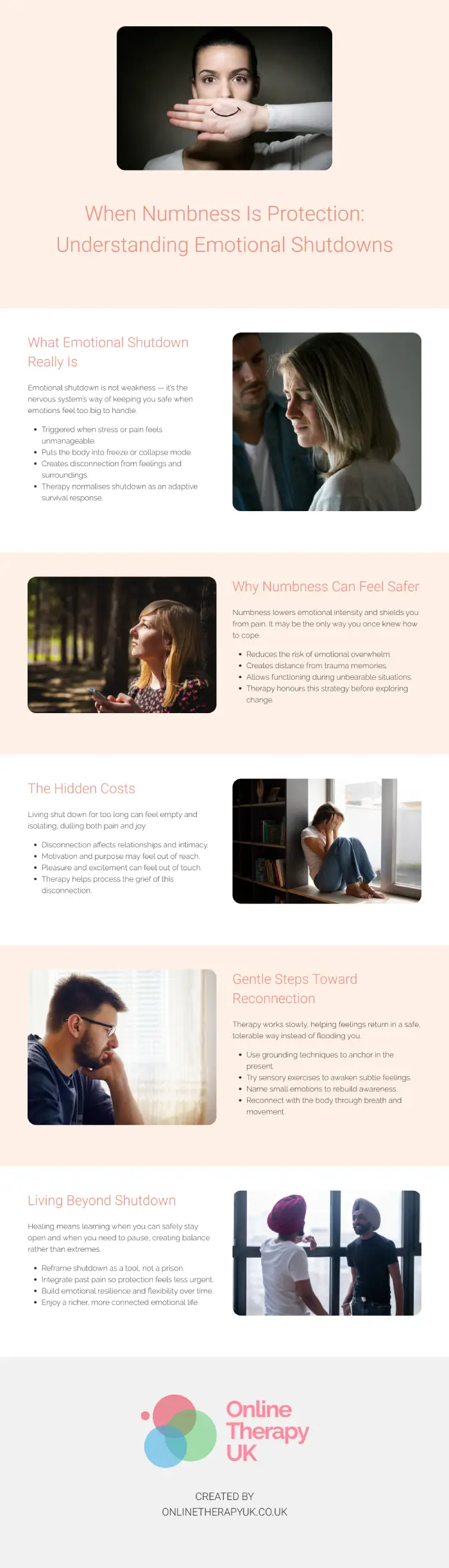
There are times when feelings seem to disappear. Instead of sadness, anger, or fear, there is only emptiness — a sense of being disconnected from yourself and the world around you. For many, this emotional shutdown feels confusing or even frightening, leading to worries of being “broken” or incapable of feeling.
In therapy, numbness is not seen as a failure but as a form of protection. It is the nervous system’s way of keeping you safe when emotions feel too overwhelming to manage. This blog will explore why emotional shutdowns happen, how they serve a purpose, and how therapy helps gently bring feelings back online in a way that feels safe and sustainable.
What Emotional Shutdown Really Is
Emotional shutdown is not simply a lack of feeling but a survival response. When the nervous system perceives too much threat or emotional overload, it activates a state of freeze or collapse to protect you from becoming overwhelmed.
- Shutdown is part of the body’s defence system, just like fight or flight.
- It is triggered when stress or pain feels too intense to process.
- Emotional disconnection is a way to survive unbearable situations.
- Therapy normalises shutdown as an adaptive response, not a flaw.
The Body’s Role in Numbness
Numbness is not just mental — it is a physiological state. The body lowers energy, slows heart rate, and creates a sense of detachment to conserve resources. Understanding the physical side of shutdown helps reduce shame and fear.
- The freeze response activates when fight or flight feels impossible.
- Dissociation creates distance from overwhelming sensations.
- Physical cues may include heaviness, fatigue, or feeling “spaced out.”
- Therapy helps clients learn to recognise and track these bodily states.
Why Numbness Can Feel Safer Than Feeling
When emotions are too big, too painful, or too frightening, shutting down may feel like the only option. Numbness can provide relief by turning down the volume on pain — even if it also turns down joy.
- Numbness prevents the flood of emotions from feeling unmanageable.
- It protects from re-experiencing trauma too intensely.
- Clients often feel safer staying disconnected than risking overwhelm.
- Therapy respects this protective strategy while gently encouraging reconnection.
The Emotional Cost of Shutdown
While numbness protects in the moment, living in shutdown for long periods can create its own suffering. Many clients report feeling empty, detached, or unable to connect with others, which can lead to loneliness and hopelessness.
- Shutdown dulls not only pain but also pleasure and joy.
- Relationships may feel distant or difficult to maintain.
- Clients may feel cut off from their sense of purpose or motivation.
- Therapy helps process the pain of disconnection without forcing feelings too quickly.
The Link Between Trauma and Emotional Numbing
Emotional shutdown is especially common in people with trauma histories. When danger was ongoing — whether physical, emotional, or relational — numbness became a survival tool that allowed the individual to keep functioning.
- Trauma often teaches the nervous system to stay in freeze mode.
- Early experiences of neglect or abuse increase the likelihood of shutdown.
- Dissociation becomes a habit, even in safe situations.
- Therapy works slowly to rebuild a sense of safety so shutdown is no longer needed.
Understanding Dissociation
Dissociation is closely related to emotional shutdown and can take many forms, from daydream-like states to full disconnection from memory or body. Understanding dissociation helps reduce fear when clients notice it happening.
- Dissociation is the brain’s way of protecting you from overwhelm.
- It can feel like watching life from outside your body.
- Memory gaps or “lost time” can sometimes occur.
- Therapy helps ground clients and bring them gently back to the present.
How Shutdown Affects Relationships
Emotional numbness often impacts connection with others. When feelings are muted, intimacy can feel difficult, and loved ones may misinterpret withdrawal as rejection or indifference.
- Shutdown creates distance that partners may not understand.
- Clients may struggle to express needs or receive care.
- Conflict can feel impossible to address when emotions are inaccessible.
- Therapy supports communication about numbness to prevent relational strain.
Recognising the Signs of Shutdown
Learning to recognise the early signs of emotional shutdown helps clients respond before becoming completely disconnected. Awareness is the first step toward gentle intervention.
- Physical heaviness or a sense of “fog” settling in.
- A sudden drop in energy or desire to withdraw from others.
- Difficulty thinking clearly or forming words.
- Therapy helps clients notice these signs and respond with care.
Meeting Shutdown with Compassion
Fighting shutdown or judging yourself for feeling numb only deepens the disconnection. Compassion is key to softening the response and allowing safe reconnection to feelings.
- Self-criticism adds another layer of pain to the experience.
- Compassion validates that numbness was once protective.
- Kindness toward yourself builds safety and trust internally.
- Therapy models this compassion so it can be internalised.
Gentle Steps Toward Reconnection
Reconnecting with feelings must happen gradually to avoid overwhelm. Therapy guides clients through small, manageable steps that help them feel safe while reconnecting with their emotions and bodies.
- Grounding techniques help anchor you in the present moment.
- Simple sensory exercises can begin to thaw emotional numbness.
- Journaling or naming small feelings builds emotional awareness.
- Therapy works at the client’s pace, avoiding forced exposure to pain.
The Role of the Nervous System in Healing
Working with the body is often essential for recovery from shutdown. Therapy may use approaches that support regulation of the nervous system, making emotional connection feel safer.
- Breathwork and gentle movement help reset the stress response.
- Somatic practices teach the body to tolerate more sensation.
- Regulation skills build resilience for future emotional waves.
- Therapy supports creating safety before deep emotional processing.
Balancing Protection and Connection
The goal is not to eliminate numbness entirely but to develop the ability to choose when to engage with feelings and when to pause. This balance allows clients to feel more in control of their emotional lives.
- Shutdown is reframed as a tool, not a permanent state.
- Clients learn when it is helpful and when it blocks connection.
- Greater flexibility replaces automatic disconnection.
- Therapy helps clients develop trust in their ability to handle feelings.
Integrating Past Pain
Eventually, therapy supports processing the experiences that made shutdown necessary in the first place. When past pain is integrated, the need for constant protection begins to ease, and emotional life feels richer.
- Unprocessed memories are explored safely and at the right pace.
- Grieving past harm helps release frozen emotions.
- Integration allows the nervous system to rest in the present.
- Therapy helps clients reclaim a fuller emotional range.
Living Beyond Shutdown
As numbness softens, life begins to feel more vibrant and connected. Clients often report feeling more present, more engaged, and more capable of experiencing joy alongside pain.
- Energy returns as the nervous system becomes less burdened.
- Relationships deepen through emotional availability.
- A fuller emotional range becomes possible, not overwhelming.
- Therapy supports maintaining balance through ongoing practice.
Conclusion
Emotional shutdown is not a sign of weakness but a sign that your system has worked hard to protect you. While numbness can feel painful and isolating, it is often the very thing that allowed you to survive when feelings were too big to bear. Therapy helps you meet this state with compassion, gently thaw its hold, and reconnect with your emotional world at a pace that feels safe.
At Online Therapy UK, we believe that numbness carries wisdom as well as pain. By learning to understand your emotional shutdowns, you can honour their protective role while finding ways to feel, connect, and live more fully. Healing does not mean rushing to feel everything at once — it means learning that you can safely hold whatever arises, one step at a time.