Relationships are at the core of human experience. Whether romantic, platonic, familial, or professional, the way we connect with others is shaped by our earliest emotional bonds. If you’ve ever wondered why you crave closeness, avoid intimacy, or fear abandonment, the answer may lie in your attachment style.
Attachment theory provides a powerful lens for understanding how we behave in relationships—why we love the way we do, why we struggle to trust, and how we respond to emotional closeness and conflict. By learning about your own attachment style, you can gain insight into your relationship patterns, improve emotional awareness, and develop healthier connections with others.
In this post, we’ll explore what attachment styles are, how they develop, the four main types, and how they play out in adult relationships. We’ll also discuss how therapy and self-reflection can help you move toward more secure and fulfilling bonds.
What Are Attachment Styles?
Attachment styles are psychological frameworks that shape how we relate to others emotionally. Developed in early childhood through interactions with caregivers, they serve as internal “blueprints” for connection. These blueprints influence how we handle closeness, trust, independence, and conflict.
Attachment theory was first introduced by John Bowlby in the 1950s, with further contributions by Mary Ainsworth. While originally studied in the context of child development, researchers later recognised that attachment patterns persist into adulthood—especially in romantic relationships.
How Attachment Styles Develop
From infancy, we depend on caregivers to meet our physical and emotional needs. When those needs are met consistently and lovingly, we learn that the world is safe, that others can be trusted, and that we are worthy of love. This leads to a secure attachment.
But when caregiving is inconsistent, neglectful, overly controlling, or frightening, we may develop insecure attachment styles. These are adaptive responses—survival strategies shaped by the child’s environment. Over time, they become ingrained ways of relating, often outside our conscious awareness.
It’s important to note that attachment styles aren’t fixed labels. They exist on a spectrum, and with awareness and effort, they can evolve.
The Four Main Attachment Styles
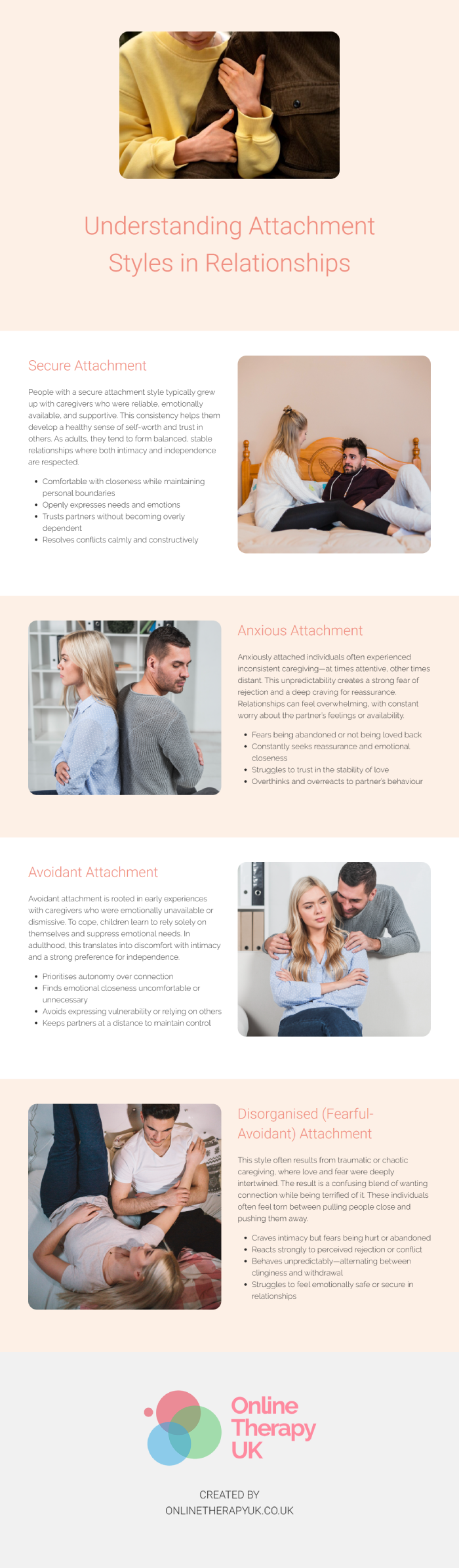
There are four commonly recognised adult attachment styles:
- Secure Attachment
- Anxious Attachment
- Avoidant Attachment
- Disorganised (Fearful-Avoidant) Attachment
Each style has its own emotional patterns, strengths, and challenges in relationships. Let’s take a closer look at each one.
Secure Attachment
People with a secure attachment style generally had caregivers who were consistently responsive, emotionally available, and supportive. As a result, they feel confident in their ability to give and receive love.
Characteristics of Secure Attachment:
- Comfortable with intimacy and autonomy
- Able to communicate needs and feelings clearly
- Trusting of others without being overly dependent
- Capable of resolving conflict in a healthy way
- Emotionally responsive and empathetic
In relationships, securely attached people tend to build strong, trusting bonds. They can express vulnerability without fear and are generally good at maintaining boundaries without shutting people out.
Anxious Attachment
Anxiously attached individuals often experienced inconsistent caregiving—sometimes loving, sometimes dismissive. As a result, they become hyper-aware of signs of rejection and crave constant reassurance.
Characteristics of Anxious Attachment:
- Intense fear of abandonment or rejection
- Constant need for validation and closeness
- Difficulty trusting that love is secure
- Tendency to overanalyse partner’s behaviour
- Prone to jealousy and emotional highs and lows
In relationships, anxious individuals may become clingy, overly dependent, or preoccupied with their partner’s availability. They may struggle with boundaries and feel unsafe unless they’re receiving constant affection and reassurance.
Avoidant Attachment
Avoidant attachment develops when caregivers are emotionally distant, neglectful, or disapproving of emotional expression. These children learn to self-soothe and suppress their needs.
Characteristics of Avoidant Attachment:
- Strong need for independence
- Discomfort with emotional closeness or vulnerability
- Difficulty expressing feelings
- Tendency to downplay the importance of relationships
- High value placed on self-sufficiency
In relationships, avoidant individuals may seem emotionally distant or detached. They often struggle to open up or commit fully, and may retreat when conflict or emotional intensity arises. They may view emotional dependency as weakness.
Disorganised (Fearful-Avoidant) Attachment
This attachment style often stems from trauma, abuse, or extreme inconsistency in childhood caregiving. The caregiver is experienced as both a source of comfort and a source of fear, leading to a deep internal conflict.
Characteristics of Disorganised Attachment:
- Desire for closeness paired with fear of intimacy
- Highly sensitive to rejection, but fearful of trusting
- Emotional dysregulation and unpredictability
- Conflicting behaviours—clinging one moment, withdrawing the next
- Difficulty feeling safe in relationships
In relationships, disorganised individuals may crave love but sabotage it. They may find it hard to regulate their emotions or make sense of their feelings. Without support, this style can lead to chaotic or abusive dynamics.
How Attachment Styles Affect Adult Relationships
Attachment styles influence many aspects of adult relationships, including:
Communication
Secure individuals are open and clear. Anxious types may be indirect or overly expressive. Avoidant partners might shut down or avoid difficult conversations. Disorganised individuals may switch between extremes.
Conflict
Secure couples manage conflict constructively. Anxious individuals may become overwhelmed and fear abandonment. Avoidant types may withdraw. Disorganised partners might escalate or disengage unpredictably.
Intimacy
Securely attached people are comfortable with closeness. Anxious individuals often crave it but fear losing it. Avoidant people may avoid or delay intimacy. Disorganised types may alternate between intense closeness and sudden detachment.
Trust
Secure individuals trust their partners unless given a reason not to. Anxious people may constantly seek reassurance. Avoidant people may distrust emotional dependence. Disorganised individuals may trust and distrust simultaneously.
These dynamics often create attachment pairings that reinforce insecurities—such as anxious-avoidant partnerships, which can lead to push-pull cycles of closeness and withdrawal.
Can Attachment Styles Change?
Yes. While attachment styles are rooted in early experiences, they are not permanent. Through self-awareness, reflection, and healing experiences, people can develop more secure ways of relating.
Factors that support change include:
- Therapy: A therapeutic relationship can offer a corrective emotional experience, helping you build trust, emotional regulation, and self-worth.
- Healthy relationships: Being with a securely attached partner or friend can model new relational patterns.
- Self-reflection: Understanding your triggers, patterns, and needs allows you to make conscious choices rather than react from old scripts.
- Boundaries and communication skills: Learning how to express needs and set healthy limits is key to shifting from insecurity to security.
- Inner child work: Reconnecting with the part of yourself that developed these attachment patterns can lead to deep healing.
The journey isn’t about becoming “perfect” at relationships—it’s about becoming more emotionally aware, resilient, and open to connection.
How to Identify Your Attachment Style
There are several ways to explore your attachment style:
- Reflect on past relationships: Do you often feel anxious, avoidant, or stable? What are your common triggers?
- Notice how you respond to intimacy and conflict: Do you withdraw, cling, seek control, or communicate openly?
- Pay attention to emotional regulation: Can you soothe yourself, or do you need others to do it for you?
- Take an attachment style quiz: Tools like the Attachment Style Questionnaire (ASQ) or online versions can offer insight.
- Speak with a therapist: A trained professional can help you understand your patterns and guide you toward change.
Remember, attachment styles aren’t diagnoses—they’re patterns. And those patterns can be rewritten.
How Therapy Can Help with Attachment Issues
If your attachment style is causing distress, therapy can be a powerful tool for growth and healing. Here’s how:
- Build a secure base: The therapeutic relationship can model trust, consistency, and emotional safety.
- Unpack your relational history: You can explore the origins of your attachment style without blame or shame.
- Work through trauma: Therapy can address unresolved grief, neglect, or abuse that shaped your attachment wounds.
- Practise new behaviours: With support, you can experiment with expressing needs, setting boundaries, or staying present during conflict.
- Strengthen self-worth: Therapy helps you build a more stable, compassionate relationship with yourself.
Therapeutic approaches such as attachment-based therapy, emotionally focused therapy (EFT), schema therapy, or psychodynamic therapy are particularly effective for attachment work.
Final Thoughts: Healing Starts with Awareness
Understanding your attachment style is not about putting yourself in a box or blaming your parents—it’s about recognising the patterns that shape your emotional life and relationships. When you name these patterns, you gain the power to change them.
Whether you’re secure, anxious, avoidant, or disorganised, your attachment style is a reflection of what you’ve learned—not who you are at your core. And like any learned behaviour, it can be unlearned. With compassion, support, and conscious effort, you can move toward more secure, loving, and balanced relationships.
You deserve to feel safe in love.
You deserve to trust and be trusted.
You deserve connection that nourishes rather than depletes.
By understanding your attachment style, you take the first step toward creating the kinds of relationships that bring healing, joy, and true intimacy.